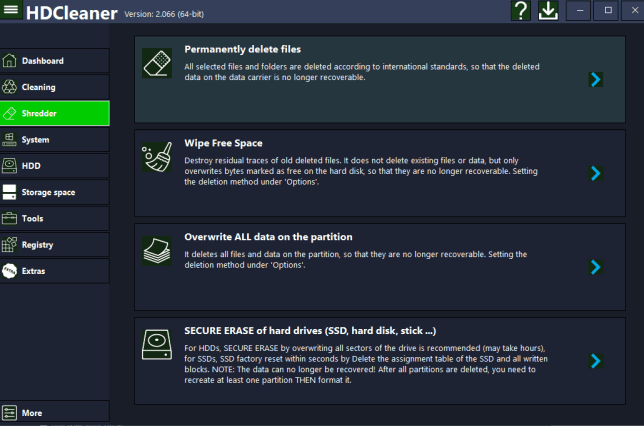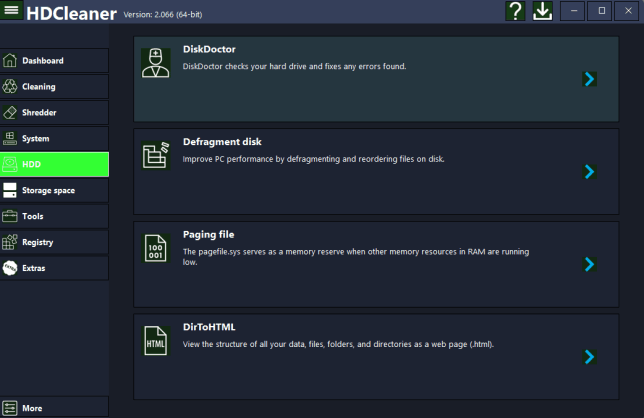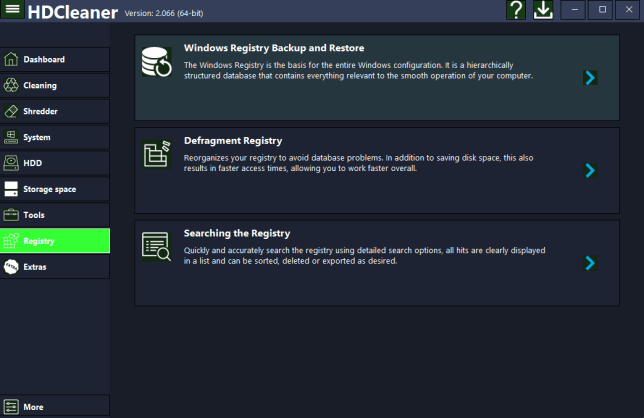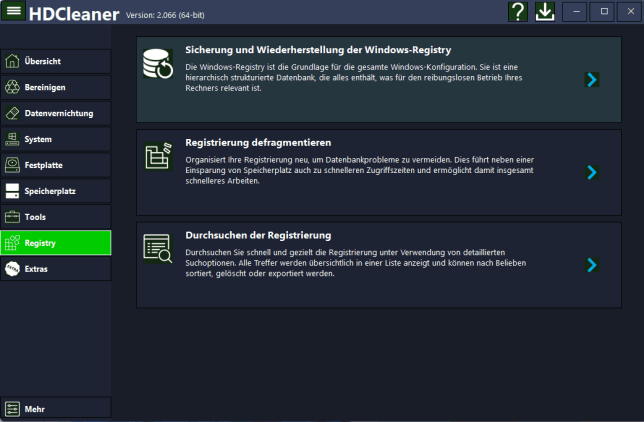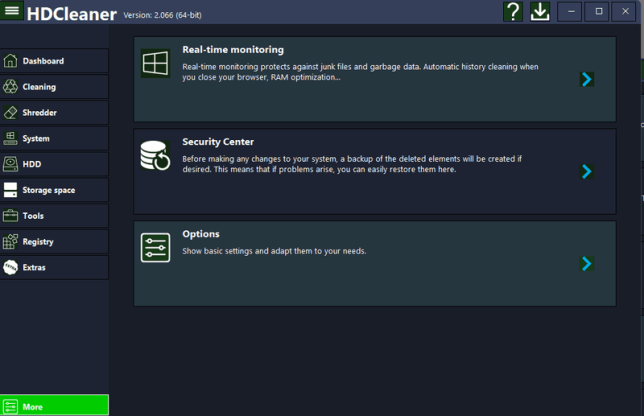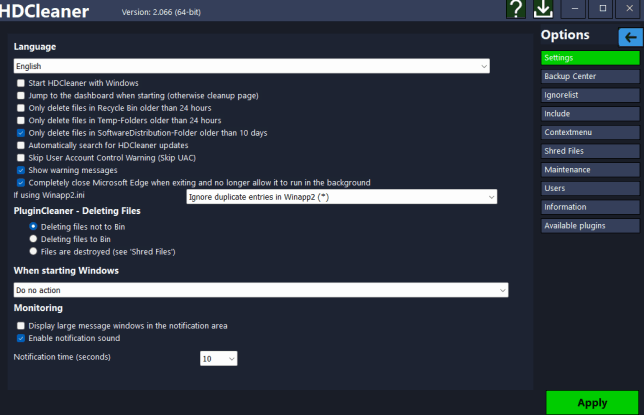
HDCleaner offers a comprehensive suite of programs for Windows system maintenance. Whether you want to declutter your hard drive, clean the registry, encrypt data, remove user traces, completely back up the registry, defragment it, or perform a quick scan – you'll always find the right tool in the clearly arranged "toolbox." With one-click optimization, the application organizes and cleans the registry, destroys internet traces, removes temporary files, defragments the registry, finds hard drive errors, and optimizes system startup. Optimized for use with solid-state drives (SSD) and hard disk drives (HDD).

With over 5,500 cleaning and repair functions, HDCleaner reduces junk files to a minimum, freeing up more system resources for Windows, using less memory, and running error-free, resulting in better PC performance.
HDCleaner lets you add any program on your system to have its data cleaned.
Supports Winapp2.ini.
Optimized for use with solid-state drives (SSD) and hard disk drives (HDD).

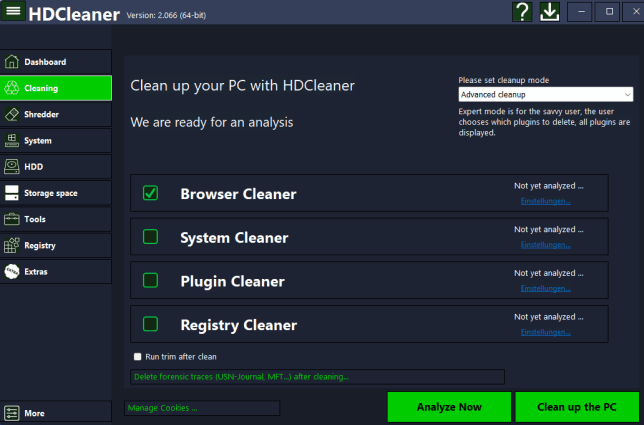
HDCleaner supports three cleaning modes:
Simple Cleanup - HDCleaner automatically scans for internet traces and junk files, which can be easily deleted. No user settings are required.
Standard Cleanup - This option is for standard users. The user determines which plugins should be deleted. Only the most commonly used plugins are displayed.
Advanced Cleanup - Expert mode is designed for experienced users. The user determines which plugins should be deleted. All plugins are displayed.
Prevent unnecessary programs from starting when your computer boots up. When you start your computer, more than just Windows loads. All of these automatically opening programs consume system memory and can slow down performance. Fortunately, managing startup programs isn't difficult with HDCleaner.
Uninstall programs you don't use; they only slow down your computer. This frees up disk space and saves resources. All associated files, settings, and registry entries will also be removed.
megapack syren de mer multipenetration milf new
Historically, older female characters were often relegated to one of two tropes: the "passive problem"—a character defined by frailty or disability—or "romantic rejuvenation," where the woman attempts to reclaim her youth through a romantic affair. Recent studies highlight a persistent on-screen disparity; for instance, characters over 50 are significantly more likely to be men, outnumbering women in this age bracket by nearly 4 to 1 in films. Women Over 50: The Right to be Seen on Screen
The landscape for mature women in entertainment and cinema is undergoing a profound transformation, moving from a "narrative of decline" toward a new era of visibility and influence. Historically, the industry has favored female youth, with many actresses seeing their leading roles dwindle after age 30. However, recent years have seen a "ripple" of change turn into a "wave" as women over 50 and 60 anchor major films, lead prestige television, and win top accolades. Breaking the "Narrative of Decline"
Historically, older female characters were often relegated to one of two tropes: the "passive problem"—a character defined by frailty or disability—or "romantic rejuvenation," where the woman attempts to reclaim her youth through a romantic affair. Recent studies highlight a persistent on-screen disparity; for instance, characters over 50 are significantly more likely to be men, outnumbering women in this age bracket by nearly 4 to 1 in films. Women Over 50: The Right to be Seen on Screen
The landscape for mature women in entertainment and cinema is undergoing a profound transformation, moving from a "narrative of decline" toward a new era of visibility and influence. Historically, the industry has favored female youth, with many actresses seeing their leading roles dwindle after age 30. However, recent years have seen a "ripple" of change turn into a "wave" as women over 50 and 60 anchor major films, lead prestige television, and win top accolades. Breaking the "Narrative of Decline"