Originally written: 3/14/2012; last Web page update: 3/13/2020, referencing rEFInd 0.12.0
This Web page is provided free of charge and with no annoying outside ads; however, I did take time to prepare it, and Web hosting does cost money. If you find this Web page useful, please consider making a small donation to help keep this site up and running. Thanks!
| Donate $1.00 | Donate $2.50 | Donate $5.00 | Donate $10.00 | Donate $20.00 | Donate another value |
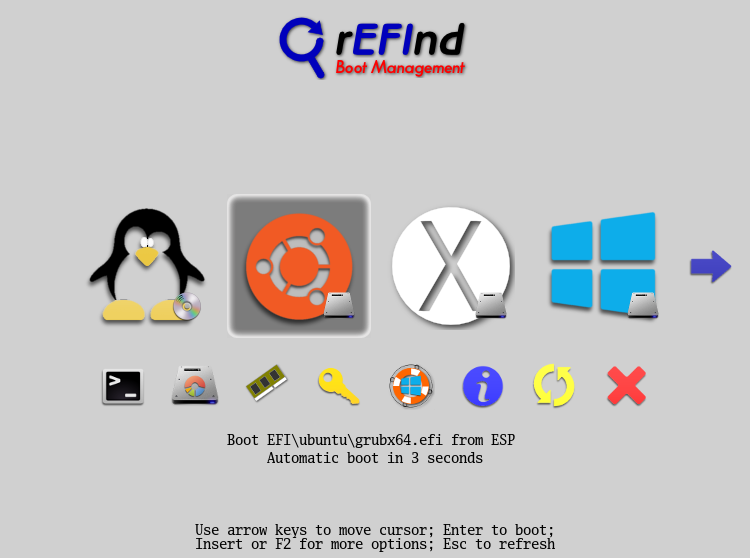
This page describes rEFInd, my fork of the rEFIt boot manager for computers based on the Extensible Firmware Interface (EFI) and Unified EFI (UEFI). Like rEFIt, rEFInd is a boot manager, meaning that it presents a menu of options to the user when the computer first starts up, as shown below. rEFInd is not a boot loader, which is a program that loads an OS kernel and hands off control to it. (Since version 3.3.0, the Linux kernel has included a built-in boot loader, though, so this distinction is rather artificial these days, at least for Linux.) Many popular boot managers, such as the Grand Unified Bootloader (GRUB), are also boot loaders, which can blur the distinction in many users' minds. All EFI-capable OSes include boot loaders, so this limitation isn't a problem. If you're using Linux, you should be aware that several EFI boot loaders are available, so choosing between them can be a challenge. In fact, the Linux kernel can function as an EFI boot loader for itself, which gives rEFInd characteristics similar to a boot loader for Linux. See my Web page on this topic for more information.
Modern audiences crave the slow burn—the buildup of tension where every glance or accidental touch carries weight. This phase allows for deep character development before the physical relationship even begins. 2. Popular Tropes: Why We Love the Familiar
At their core, romantic storylines are optimistic. They suggest that despite the chaos of the world, connection is possible and worth the struggle. The Verdict
Partners who support each other’s individual dreams rather than requiring one person to sacrifice everything for the sake of the relationship. www indian hindi sexy video com
By watching characters choose between love and power, or love and safety, we clarify what we value in our own real-world relationships.
Here is a deep dive into the mechanics of romantic storylines and why they remain the most powerful driver in media and literature. 1. The Anatomy of a Compelling Romantic Storyline Modern audiences crave the slow burn—the buildup of
But what makes a romantic storyline truly resonate? Why do some fictional couples live in our heads rent-free for decades, while others feel like cardboard cutouts?
Tropes are the building blocks of romantic storylines. While they can be clichés if handled poorly, they provide a comfortable framework for exploring complex emotions. Popular Tropes: Why We Love the Familiar At
The best stories feature characters who have a reason not to be in a relationship. Perhaps they are afraid of vulnerability, haunted by a past betrayal, or focused entirely on a non-romantic goal. The romance serves as the catalyst for them to face their own flaws.
This is the "Romeo and Juliet" factor. Family feuds, career rivalries, or literal wars provide the pressure cooker that makes the eventual union feel earned and triumphant.
Beyond entertainment, romantic storylines serve as a mirror for our own lives. They help us:
copyright © 2012–2020 by Roderick W. Smith
This document is licensed under the terms of the GNU Free Documentation License (FDL), version 1.3.
If you have problems with or comments about this Web page, please e-mail me at Thanks.
Return to my main Web page.