|
Customer Area |
 |
|
 Web Site languages:
|
|
|
|
 |
|
|
|
|
PenProtect is the most comprehensive and secure solution to password-protect the files within your USB Flash Drive, Flash Memory, Pen Drive or USB Stick. |
|
Files and folders are encrypted and protected using your Password and a special technique (AES algorithm). |
|
The encryption is currently the only secure system to protect any data. |
How to password protect Flash Drive, Pen Drive or USB Stick? Use PenProtect! |
|
|
Main features of PenProtect:
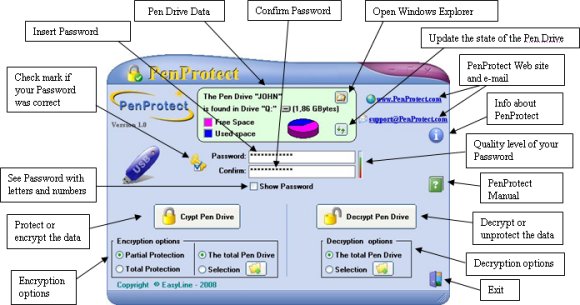
- PenProtect requires no installation. It is a single file located in the home folder of your USB Flash Drive, Flash Memory, Pen Drive, USB Key or USB Stick.
- Data protection is performed using an AES encryption (256-bit key) without changing the USB Flash Drive, Flash Memory or Pen Drive partition.
- Two protection levels (Partial and Total) to password protect USB Flash Drive.
- Ability to encrypt - decrypt only required files or folders.
- Immediate use of PenProtect to secure Pen Drive or protect Flash Drive or encrypt USB Stick.
- No size limit of encrypted files.
- Unique and individual protection for every Pen Drive with your Password.
- With PenProtect you can have a password USB protection - USB security - USB encryption - USB hide with many devices. Some example are: Flash Drive password protection, secure encrypt Pen Drive files and folders, secure Stick USB data, protect Flash Drive Memory files and folders, password secure Flash Drive, USB Stick encryption data, data Pen Drive password protection, secure USB files and folders or password protect Stick data
- PenProtect comes with an internal manual that can be viewed with no Internet connection.
- Program PenProtect comes in many languages.
- PenProtect is compatible with all Microsoft Windows Operating System, also with the new Windows Seven and with 64 bit OS:
- Free technical
assistance with Live Support!


 (Click on the image to enlarge)
 |
The Flash Drive, Flash Memory, Pen Drive or USB Stick is a USB Flash Memory Drive and can support up to 128GB disk space. A 8GB is 5600 times more than a 1.44MB floppy disk! A Flash Drive USB disk is a plug and play device. Simply plug it into any USB port and the computer will automatically detect it as a removable drive. Now you can read, write, copy, delete and move data from your hard disk drive to the Flash Drive or vice versa. |
Thanks to its small size, absence of mobile mechanisms (unlike a common hard disk) and affordable price, the Pen Drive is becoming increasingly popular among consumers. |
|
Due to its increased popularity, prices have reduced and GByte storage has increased. Unfortunately, users can often forget their Pen Drive in a computer, allowing other users to access their personal data. PenProtect is meant to secure your data in cases such as these. |
|
PenProtect software was created to password protect USB Flash Drive or password protect Pen Drive. PenProtect requires no installation. |
| PenProtect is useful to protect your data but is fundamental to solving the problems of privacy that are often found in offices or companies. |
| PenProtect is especially indicated in a business, industrial and military (secret industrial - secret military) protection of data on production activity or organization. |
Animal Behavior and Veterinary Science: Bridging the Gap Between Mind and Medicine
In veterinary science, behavior is often the first clinical sign of a physical ailment. A cat that stops grooming might be suffering from arthritis; a dog that becomes suddenly aggressive might be experiencing neurological pain. By integrating behavioral science, veterinarians can diagnose underlying medical issues much faster than through physical exams alone. Why Behavior Matters in the Clinic
For decades, veterinary medicine focused almost exclusively on the physical health of animals—vaccinations, surgeries, and the eradication of parasites. However, as our understanding of the animal kingdom has evolved, so too has the realization that mental and physical health are inextricably linked. Today, the intersection of represents one of the most dynamic and essential fields in modern animal care. The Evolution of Clinical Ethology
The integration of behavior into veterinary science serves three primary purposes: 1. Reducing Stress and Fear-Free Care
Clinical ethology—the study of animal behavior in a veterinary context—has shifted from a niche interest to a core component of general practice. This change is driven by the understanding that a "healthy" animal is not merely one free of disease, but one that is mentally stimulated and emotionally stable.
For endangered species in captivity, veterinary science uses behavioral enrichment to mimic natural environments. This is crucial for successful breeding programs and the eventual reintroduction of species into the wild. The Future: AI and Behavioral Diagnostics
Animal behavior and veterinary science are two sides of the same coin. As we continue to peel back the layers of animal consciousness, the veterinary profession will continue to move toward a more holistic, "whole-animal" approach. By treating the mind as carefully as we treat the body, we ensure a higher quality of life for the creatures that share our world.
In agricultural science, understanding the herd behavior and stress responses of cattle, pigs, and poultry is vital. Lower stress levels during handling lead to better immune systems, higher growth rates, and overall better food quality.
We are entering an era where technology is enhancing the vet’s ability to "read" behavior. Wearable technology—similar to fitness trackers for humans—can now monitor an animal’s sleep patterns, scratching frequency, and activity levels. In the near future, AI algorithms will likely assist veterinary scientists in predicting illness based on subtle behavioral deviations long before physical symptoms appear. Conclusion
Behavioral issues are the leading cause of "relinquishment"—the surrender of pets to shelters. When a veterinarian can address separation anxiety, compulsive behaviors, or inter-pet aggression through a combination of behavioral modification and pharmacology, they aren’t just treating a symptom; they are saving a life by preserving the bond between the owner and the animal. 3. Pharmacology and the "Brain-Body" Connection
Zooskool Wwwrarevideofreecom Free |link| ✪
Animal Behavior and Veterinary Science: Bridging the Gap Between Mind and Medicine
In veterinary science, behavior is often the first clinical sign of a physical ailment. A cat that stops grooming might be suffering from arthritis; a dog that becomes suddenly aggressive might be experiencing neurological pain. By integrating behavioral science, veterinarians can diagnose underlying medical issues much faster than through physical exams alone. Why Behavior Matters in the Clinic
For decades, veterinary medicine focused almost exclusively on the physical health of animals—vaccinations, surgeries, and the eradication of parasites. However, as our understanding of the animal kingdom has evolved, so too has the realization that mental and physical health are inextricably linked. Today, the intersection of represents one of the most dynamic and essential fields in modern animal care. The Evolution of Clinical Ethology zooskool wwwrarevideofreecom free
The integration of behavior into veterinary science serves three primary purposes: 1. Reducing Stress and Fear-Free Care
Clinical ethology—the study of animal behavior in a veterinary context—has shifted from a niche interest to a core component of general practice. This change is driven by the understanding that a "healthy" animal is not merely one free of disease, but one that is mentally stimulated and emotionally stable. Animal Behavior and Veterinary Science: Bridging the Gap
For endangered species in captivity, veterinary science uses behavioral enrichment to mimic natural environments. This is crucial for successful breeding programs and the eventual reintroduction of species into the wild. The Future: AI and Behavioral Diagnostics
Animal behavior and veterinary science are two sides of the same coin. As we continue to peel back the layers of animal consciousness, the veterinary profession will continue to move toward a more holistic, "whole-animal" approach. By treating the mind as carefully as we treat the body, we ensure a higher quality of life for the creatures that share our world. Why Behavior Matters in the Clinic For decades,
In agricultural science, understanding the herd behavior and stress responses of cattle, pigs, and poultry is vital. Lower stress levels during handling lead to better immune systems, higher growth rates, and overall better food quality.
We are entering an era where technology is enhancing the vet’s ability to "read" behavior. Wearable technology—similar to fitness trackers for humans—can now monitor an animal’s sleep patterns, scratching frequency, and activity levels. In the near future, AI algorithms will likely assist veterinary scientists in predicting illness based on subtle behavioral deviations long before physical symptoms appear. Conclusion
Behavioral issues are the leading cause of "relinquishment"—the surrender of pets to shelters. When a veterinarian can address separation anxiety, compulsive behaviors, or inter-pet aggression through a combination of behavioral modification and pharmacology, they aren’t just treating a symptom; they are saving a life by preserving the bond between the owner and the animal. 3. Pharmacology and the "Brain-Body" Connection
And now...
How to password protect
your USB Flash Drive? |
 |
 |
|
For more information, read the following pages:
- Some Screenshots to see how is it easy to secure Flash Drive or protect Pen Drive or encrypt USB Stick files and folders.
- PenProtect Manual.
- F.A.Q. (Frequently Asked Questions) about PenProtect.
- PenProtect Technical Support.
|
|
|
|
|